 So before Koko explodes with banana expletives and grunts of joy, let quiet ol' Slothrop say that he doesn't like what he just did, namely, root against Federer. I mean, Slothy is glad that this youngster won his first championship, and even more glad Federer didn't win his sixth. The issue is not, of course, an envy of large silver cups, but a feeling of, ok, Roger, you have plenty, let some other kind play on the swing. But as I examine this feeling, it's black and rotten at its core. Cheering against athletes, rather than for your man or your team reeks of envy, and envy is a real downer. Who is Slothy to dictate how many large bulbous silver punch bowls is enough for one man? And so what if Coyote is a Douche who probably runs the Swiss bank tax fraud cartel? Is it my place to instruct him on ways he can wear fewer than seven emblems of his initials and still retain a sense of confidence? I hope you know what I mean Koko. I felt mean spirited and that's not good. Coyote is a human being whatever lessons he has yet to learn will be learned without the malice of others.
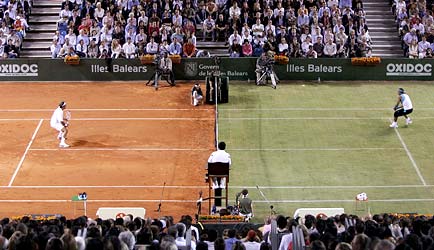 Or how about this: hold the fourth Major only once every four years, but play it on the Moon. It would be expensive, obviously, but think of how viscous and uncanny everything would look, like a nightmare. Anyway, before we start hating on the surfaces, let's remember that a time once ruled when three of the four Majors were played on grass, a ubiquity that altogether sucked and that I cheerfully dismiss as so much historical flotsam.
Nor is there anything wrong with getting behind diversity. Federer has forced tennis to evolve, and indisputably it has. But now we need new players, new talents, to gain experience and confidence so that they can contribute to the sport in a lasting and transformative way. By winning one more antique bell, Federer does not move that cause forward; he blocks it. Of course he can, and should, continue to win. But we no longer profit from his dominance as we once did. His reign from 2003 to 2006, when he essentially played unchallenged, stimulated a revolution in style, technique, and overall athleticism. For that we owe him everything. The full effects of that upheaval are only now beginning to be felt; Nadal was a premature antithesis, and even he took until 2007-08 to mature into a flexible, all-court and all-surface opponent. More different men winning more often is a good thing for tennis, all things being equal, and we want what's best for the sport. What most benefits tennis now is for Murray, del Potro, Djokovic, Simon, Tsonga, Monfils (though he never will, because he's a nutcase), and Verdasco (hey, he's still young enough) to start winning important tournaments. Del Potro, the youngest, stepped up first, and now he can win anywhere; he'll always be a threat. The others need to follow suit, and once they have, they too will be constant, floating threats in the draw. The more danger in the draw, the better the tournament, and the better the tournament, the more significant the win.
There is a good reason, provided you practice it sanely, to support a player's loss, if that loss will make the field stronger. But that's beside the point. Del Potro played even with Federer, who was playing at his best off the ground, for four sets over three and a half hours. Then Federer cracked, and del Potro earned his win. Wanting that to happen is not the same thing as wanting his opponent to crash. I'm glad it was a close match, that each pushed the other as hard as he could, and I'm most glad that the one who pushed harder was, I believe, the one who deserved it more. And here, unlike in Big Whiskey, deserve has everything to do with it.


No comments:
Post a Comment