 He came into this tournament with a losing record (0-6) against Federer, with a draw that placed him opposite Murray in the quarterfinals, Nadal in the semifinals, and Federer in the final, and while Marin Cilic bounced Murray from the tournament before del Potro had his chance, the Argentine nevertheless became the only player in history to defeat both Federer and Nadal in a Major, a feat made even more memorable and impressive by the mere twenty-four hours separating those wins. Taking out the two best players of a generation in two days, that achievement dwarfs even the spectacular tournament win. Somebody goes home with that trophy every year; nobody, ever, anywhere has topped both Nadal and Federer in a Slam in twenty-four hours. That is the honor of the year. That, everybody, is history.
He came into this match, his first Major final appearance, with no expectation other than to work as hard as possible and accept the result, and, unlike Murray, who last year capitulated in one of the worst finals I can remember watching, his only expectation--a disciplined effort--relieved him of the burden most players wear so conspicuously against Federer: greatness. He felt confident but not entitled; he moved quickly but did not scramble; he hit hard but not wildly or recklessly; he controlled everything he did and abandoned everything else. As a result, after the initial discomfort of contesting a match against the five-time defending champion on his best surface in front of a crowd that adores him, del Potro settled in for a protracted fight. He trusted his game, his mind, his stamina. Even in the fifth set, looking exhausted and empty, obviously struggling to stay on his feet after four hours of intense, taxing athletics, he knew he could keep going, however long it took, until he broke his opponent. And he did. Only twenty years old, in his first Major final, playing a man he'd never beaten and who in their most recent meeting thoroughly dismantled him: he put all that aside, forgot about everything but now, and became the first player other than Nadal to beat Federer in a Slam final.
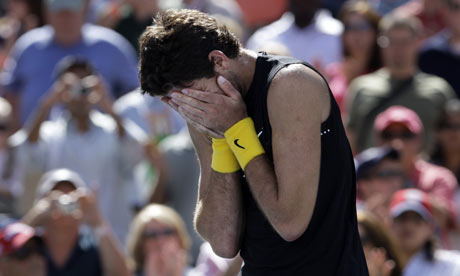
 When Federer cries--we've seen him do so after winning fifteen Majors, and losing two, and after beating Sampras in the Wimbledon fourth round back in 2001, and whenever else--he does so with a theatrical flourish, body crumpling, on his knees, face contorted. The sentiment reads melodramatically and feels, to me, always a little maudlin, like a champion's reflex or pose, not a genuine and spontaneous emotion. When Federer's defensive backhand sailed long at 2-5 in the fifth set to give him the match, del Potro fell, really fell, like an invisible string holding him up had finally been cut, and lay there on the court, hands covering his face, chest heaving at irregular, spasmodic intervals, overwhelmed. When he got up, fingers pulling at his hair, eyes desperate and confused and utterly disbelieving, clearly lost in a vast blank nothing of happiness, he looked, for the very first time, like a twenty year old kid who will never really understand what just happened to him but will also never forget it. He didn't look at all like a trained animal, not like a veteran. Just a kid who happened, suddenly, superbly, impossibly to fulfill his life's dream. He was shocked. Shocked.
Juan Martin del Potro is the next great men's champion. He can win anywhere, on any surface. Fifteen months ago none of us had ever heard of him. A year ago he was a rising star. Six months ago he became a contender. Now he can rival the only two serious threats in men's tennis. And he's only twenty. Think about that. He has the next ten years of his life to improve, to accumulate, to adapt. The Federer-Nadal era is over. It takes more than two talents, however rare or extraordinary, to build a successful draw. It always did. And the draw is the heart of tennis. Without a diverse and robust draw, tournament play stagnates, becomes predictable, and malfunctions in a kind of iterative or recursive trauma. For the first time since the early nineties when Sampras, Courier, and Agassi emerged from obscurity to challenge Lendl, Edberg, Becker, and Wilander, tennis stands poised on a threshold that, once passed or put aside, will open the sport to new growth, greater depth, and subtler and more various competition. But before that happens, let's take a last moment to enjoy the familiar changes.
Congratulations, Delpo. I'm happy to say that I knew you could do it.


No comments:
Post a Comment